

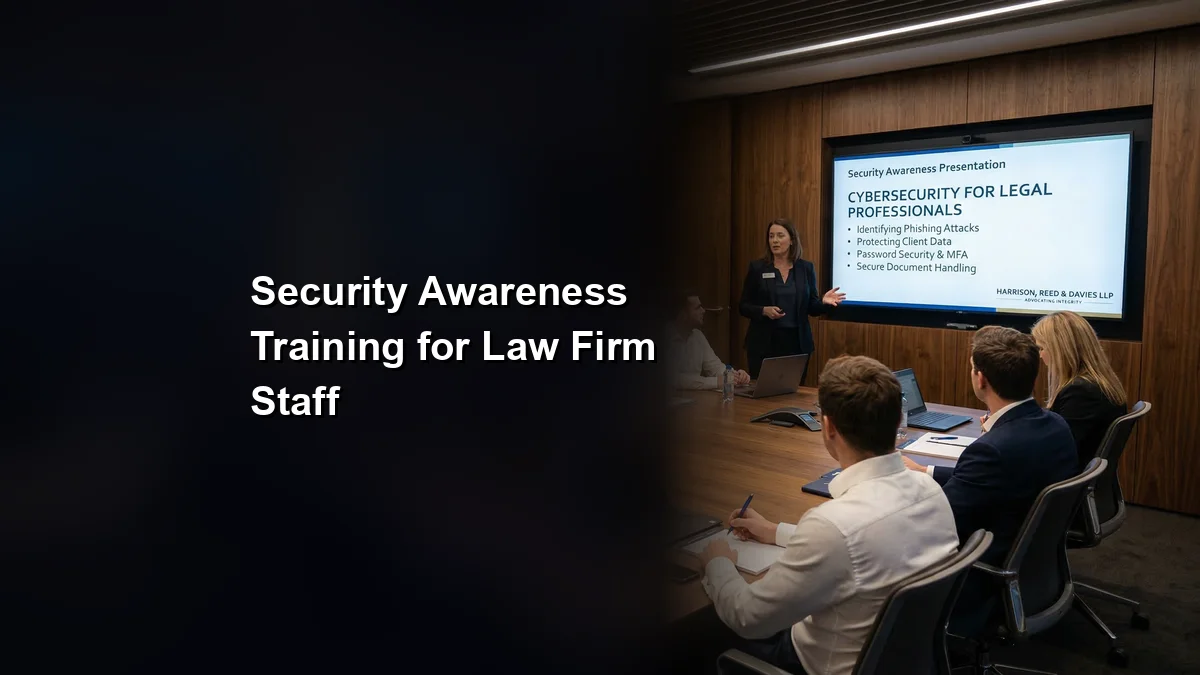
The most expensive cybersecurity breach in your law firm's future will almost certainly begin with a human decision—someone clicking a link, entering credentials on a spoofed site, or forwarding a document to the wrong address. The technology is almost secondary. According to the 2024 ABA Cybersecurity Tech Report, 36% of law firms reported experiencing a security incident in the past year. Among the firms that suffered a breach, 56% lost sensitive client information. The common denominator in most of these events is not a sophisticated zero-day exploit—it is undertrained staff operating in a high-pressure environment without adequate guidance. For managing partners and firm administrators, security awareness training is no longer a best practice: it is an ethical obligation, an insurance requirement, and in a growing number of states, a continuing education mandate.
What Do ABA Ethics Rules Require Regarding Staff Training?
Several ABA Model Rules of Professional Conduct create direct obligations related to training law firm staff on cybersecurity:
- Rule 1.1 — Competence: Comment 8 requires lawyers to "keep abreast of changes in the law and its practice, including the benefits and risks associated with relevant technology." This is not limited to attorneys—supervising lawyers bear responsibility for ensuring their entire team operates with technology competence.
- Rule 1.6(c) — Confidentiality: Requires lawyers to "make reasonable efforts to prevent the inadvertent or unauthorized disclosure of, or unauthorized access to, information relating to the representation of a client." State bar ethics committees have consistently interpreted this to include training staff on the threats that lead to inadvertent disclosure—phishing, credential theft, and social engineering.
- Rule 5.3 — Responsibilities Regarding Non-Lawyer Assistance: Partners and supervising attorneys must make "reasonable efforts to ensure that the [non-lawyer's] conduct is compatible with the professional obligations of the lawyer." This rule explicitly extends confidentiality and competence obligations to paralegals, legal assistants, receptionists, and any other support staff who handle client information.
The ABA House of Delegates reinforced these obligations in Resolution 609 (2023), urging all lawyers to "enhance their cybersecurity and infrastructure to protect confidential client information" and explicitly identifying staff training as a core component of reasonable security. The resolution's accompanying report was blunt: "Attorneys and law firms have become increasingly attractive targets for criminals engaged in cybercrimes, and this trend has unfortunately been increasing over time—despite the warnings, more robust training, and initiatives to raise awareness within the legal profession."
Which States Now Mandate Cybersecurity Training for Attorneys?
The regulatory landscape for attorney cybersecurity training is evolving rapidly. What began as voluntary guidance is becoming mandatory CLE across an increasing number of jurisdictions:
- New York: The most significant mandate in the nation. Effective January 1, 2023, New York's Supreme Court Appellate Division requires all attorneys to complete CLE coursework in cybersecurity as a condition of law practice. Required topics include inadvertent electronic disclosure of confidential information, supervision of vendors relating to data protection, cybersecurity features of legal technology, and applicable breach notification laws—directly mapping to ABA Rules 1.1, 1.6, and 5.3.
- Florida: The first state to mandate technology CLE (2018), requiring attorneys to complete coursework covering cybersecurity, data protection, and e-discovery as part of their continuing education hours.
- North Carolina: Requires one hour annually on technology topics, including cybersecurity.
- Pennsylvania and Colorado: Have implemented similar requirements for technology-focused CLE.
- 40+ jurisdictions: Have adopted the technology competence language from Rule 1.1, Comment 8, even if they have not yet mandated specific cybersecurity training hours.
All 50 jurisdictions impose an equivalent of Rule 1.6(c), meaning that in every state, reasonable efforts to prevent disclosure—which include staff training—are an ethical requirement. The question is not whether training is required, but whether your current program is adequate to satisfy the "reasonable efforts" standard your state bar would apply in an investigation.
Why Are Law Firm Staff Especially Susceptible to Phishing?
Phishing is the leading attack vector against law firms, and understanding why legal professionals are susceptible is essential to designing effective training.
LexisNexis's 2025 survey of 700+ legal professionals identified phishing as the number one cyber threat, cited by 38% of respondents overall and 44% of small firm attorneys. The legal industry faces an average of 1,055 cyberattacks per week in 2025, a 13% increase over 2024, and phishing remains the dominant entry point. A recent simulation study found that 8% of law firm employees failed phishing email simulations—an improvement from 11% the prior year, but still a serious concern in a profession where a single click can expose privileged client communications.
Several factors make law firms attractive targets for phishing:
- High-value transactions: Law firms regularly process trust account transfers, settlement payments, and real estate closings—making wire fraud attempts immediately profitable for attackers.
- Attorney authority dynamics: Staff are trained to follow partner instructions without questioning, creating ideal conditions for business email compromise attacks that impersonate managing partners or senior attorneys.
- Time pressure culture: Deadlines, court dates, and transaction closings create urgency that attackers exploit. A "please wire these funds before close of business" email is more convincing when the recipient is already under pressure.
- Public information availability: Court records, bar association directories, and LinkedIn profiles give attackers the case names, client relationships, and communication context needed to craft highly convincing spear-phishing messages.
- Non-attorney staff gaps: Legal assistants, paralegals, receptionists, and billing staff often receive far less cybersecurity training than attorneys—yet they have access to client files, financial systems, and communication channels that represent high-value attack targets.
What Topics Must Law Firm Security Training Cover?
Effective security awareness training for law firm staff goes beyond a generic "don't click suspicious links" presentation. The curriculum must be specific to the legal environment and the actual threats your firm faces:
- Phishing identification and reporting: How to identify phishing emails, spear-phishing that impersonates clients or opposing counsel, and BEC attacks. Equally important: how to report suspicious messages without escalating the threat.
- Wire transfer verification procedures: Every firm that processes trust account transactions needs a written verification protocol requiring out-of-band confirmation (a phone call to a known number) before executing any wire transfer, regardless of how legitimate the email request appears.
- Password hygiene and credential management: Use of unique passwords, password manager tools, and the specific risk of credential reuse across legal software platforms.
- Multi-factor authentication: How MFA works, why it is required, and what to do if an unexpected MFA prompt appears (a potential sign of credential compromise).
- Secure client communication: Under ABA Formal Opinion 477R, lawyers must analyze the sensitivity of information when choosing communication methods. Staff should understand which client communications require encryption or secure portal use rather than standard email.
- Social media and confidentiality: Connecting to the obligations under Rule 1.6 and ABA Formal Opinion 480—what can and cannot be shared publicly about firm matters.
- Remote work security: Secure use of home networks, VPN requirements, and the risks of using personal devices or public Wi-Fi for firm work.
- Vendor and supply chain awareness: Staff should understand that third-party vendors—case management platforms, document services, IT providers—represent attack vectors and that unusual requests from vendor contacts should be verified independently.
- Incident reporting: A clear, simple process for staff to report suspected incidents without fear of blame. The earlier a potential breach is identified, the lower the cost of response.
How Should Training Be Structured and Delivered?
A compliance-checkbox approach to security awareness training—one annual webinar followed by a quiz—does not meaningfully reduce risk. The threat landscape changes too quickly, and human behavior requires repeated reinforcement. Effective programs combine multiple modalities:
- Simulated phishing campaigns: Monthly or quarterly simulated phishing emails sent to all staff, with immediate education delivered to anyone who clicks. Tracking click rates over time is one of the clearest metrics of training effectiveness. The goal is to drive click rates below 5% and maintain them through continuous simulation.
- Short-form microlearning modules: Five to ten minute modules delivered monthly on specific topics—this week's module on recognizing BEC attacks, next week's on secure file sharing. Short, specific content outperforms long annual training in retention studies.
- Role-specific training: Attorneys, paralegals, billing staff, and receptionists face different threats and need different training content. A paralegal who processes invoices needs wire fraud training. A litigation attorney needs spear-phishing and case document security training. Generic all-staff sessions miss these distinctions.
- New hire onboarding integration: Security awareness must be part of every new employee's onboarding, regardless of role. The highest-risk period for a social engineering attack is often within the first 90 days of employment, when a new hire is least familiar with colleagues and firm procedures.
- Policy acknowledgment and documentation: Maintain records of training completion and policy acknowledgments. In the event of a breach and subsequent bar investigation or litigation, documented training programs demonstrate that the firm took "reasonable efforts" under Rule 1.6(c).
What Is the Cost of Skipping Security Training?
Beyond the direct financial exposure—the average data breach costs law firms $5.08 million, with small firm breaches averaging $36,000—undertrained staff create cascading risks specific to the legal profession:
- Bar disciplinary proceedings: A breach resulting from inadequate staff training can trigger a state bar investigation into whether the firm met its Rule 1.6(c) obligations. Disciplinary outcomes range from private reprimand to public sanction.
- Client malpractice claims: If a phishing attack leads to disclosure of privileged information or diversion of client funds, the firm faces potential malpractice liability directly tied to its security posture.
- Cyber insurance claim denial: Most cyber policies now list employee security awareness training as a required control. A breach that occurs when documented training was absent can support a carrier's denial of coverage.
- Client loss: Research consistently shows that clients who experience or learn about a firm's security breach frequently move their matters to other firms. Trust—the foundation of the attorney-client relationship—is difficult to rebuild after a visible security failure.
Security awareness training is one of the highest-return cybersecurity investments a law firm can make. The cost of a managed training program is a fraction of a single breach response, and the documentation it produces has direct value in bar proceedings, insurance applications, and client due diligence questionnaires.
What Should Law Firms Do Next?
Start by benchmarking your current training program against the requirements in your jurisdiction. If you are in New York, does your training content satisfy the specific topics required by the Appellate Division's CLE mandate? If you are in any other state, does your program create the documentation necessary to demonstrate "reasonable efforts" under Rule 1.6(c)?
At NorthStar Technology Group, we deploy and manage security awareness training programs purpose-built for law firms—including simulated phishing campaigns, role-specific training modules, and the documentation your firm needs for insurance applications and bar compliance. We pair training with the technical controls—MFA, EDR, secure email—that limit the damage when training is not enough. Explore how we approach comprehensive cybersecurity for law firms, or visit northstartechnologygroup.com/services to discuss a training and security assessment for your firm.
About the author

Ken Satkunam, CISM
President & Founder, NorthStar Technology Group
Ken has spent over 25 years in IT leadership, serving in roles from technical support to CIO for organizations as large as 23,000 employees. He founded NorthStar Technology Group in 2000 to help regulated organizations build secure, compliant, and operationally resilient technology environments. Ken holds the Certified Information Security Manager (CISM) credential from ISACA and is the co-author of the Amazon best-seller "Cyber Attack Prevention." He has been quoted in industry publications including eWeek and DM News, and NorthStar has been recognized on the Inc. 5000 list in both 2024 and 2025.