
How DoD Contractors Can Achieve C3PAO Readiness: A Guide to Passing Your CMMC Assessment

Published · Last updated · 9 min read
Where C3PAO Assessments Stand in 2026
A C3PAO is a third-party assessment organization accredited by the Cyber AB. In the CMMC program, a C3PAO performs Level 2 certification assessments against the 110 requirements in NIST SP 800-171 Revision 2. That assessment matters when a contract actually requires it. It is not automatically a condition of award for every Level 2 contract in 2026.
The program rule, 32 CFR Part 170, was published October 15, 2024 and took effect December 16, 2024. The DFARS CMMC rule, including clause 252.204-7021, was published September 10, 2025 and took effect November 10, 2025. That date started Phase 1, which allows solicitations to require CMMC Level 1 or Level 2 self-assessments as a condition of award. Phase 2 would have required a C3PAO Level 2 assessment as a condition of award beginning November 10, 2026. On July 13, 2026, the Department of War announced the immediate suspension of the CMMC Phase II requirements, along with pending and future implementation milestones. All Phase I self-assessment requirements remain in place. Check the official CMMC program page for the latest status, and see our 2026 CMMC timeline and levels guide for the broader program picture.
If a solicitation or contract calls for a C3PAO assessment, you still need to be ready: a current system security plan, evidence that the required practices are in place, and a team that can explain how the environment actually works. Preparing for that assessment is still reasonable. Treating every Level 2 contract as if a C3PAO visit is already mandatory is not. NorthStar can help with gap analysis, evidence, remediation, and coordination with a C3PAO you select. NorthStar does not perform official CMMC assessments and is not a C3PAO. For support with the readiness work, see our DoD and CMMC services.
What Is a C3PAO?
C3PAO stands for Certified Third-Party Assessment Organization, but the accurate description is a Cyber AB-accredited organization that performs CMMC Level 2 certification assessments. Find one through the Cyber AB marketplace, not by hiring your managed service provider as the assessor. Your MSP can help you get ready. It should not be the organization that assesses you.
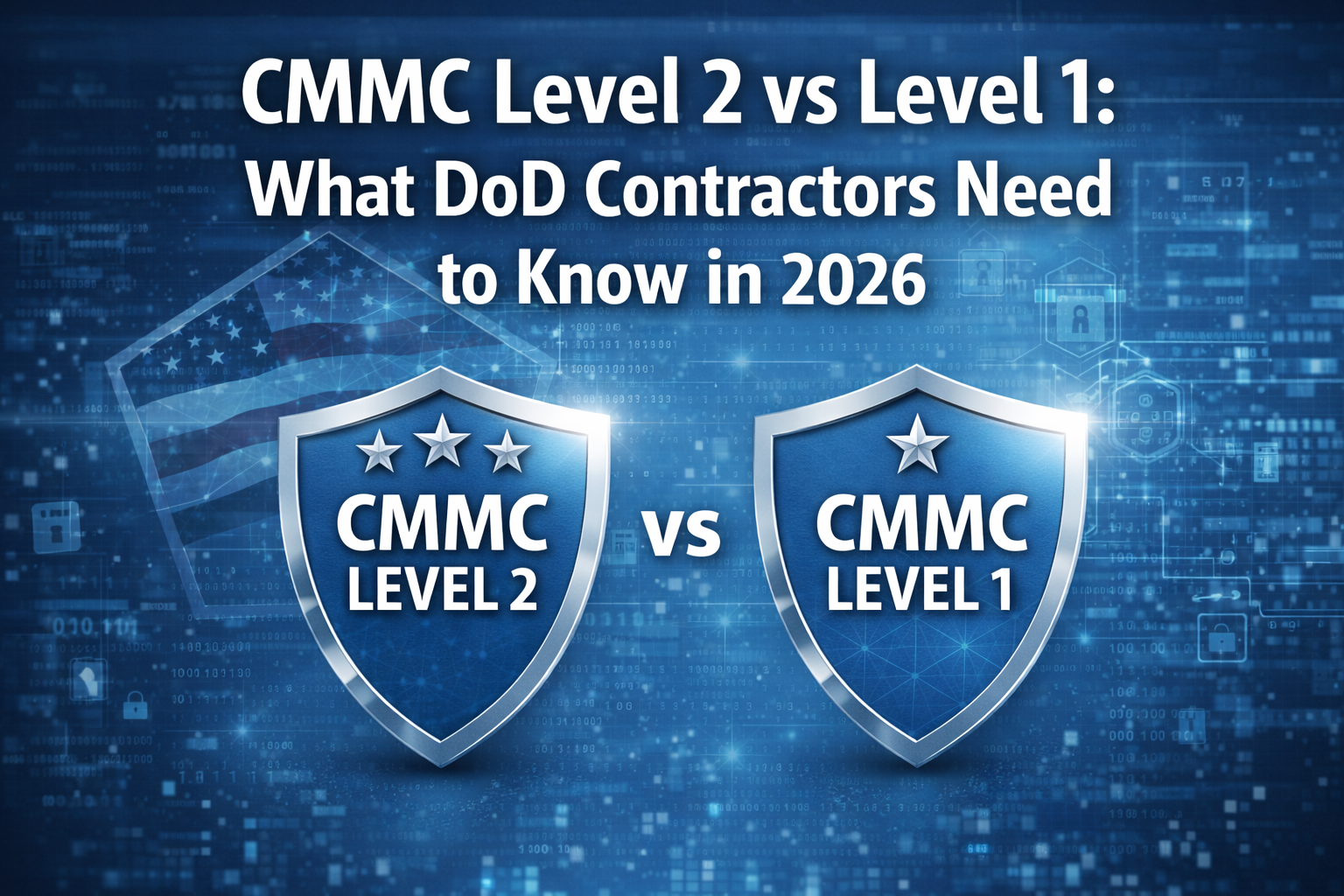
CMMC under 32 CFR Part 170 has three levels, not five. Older materials still describe a five-level model from CMMC 1.0, which is retired. Level 1 is an annual self-assessment of 17 practices aligned with FAR 52.204-21 for Federal Contract Information. Level 2 is the 110 NIST SP 800-171 Revision 2 requirements for Controlled Unclassified Information (CUI), and may be a self-assessment under Phase 1 or a C3PAO assessment when a contract requires it. Level 3 is a government assessment, typically by DCMA's Defense Industrial Base Cybersecurity Assessment Center (DIBCAC), against 800-171 plus enhanced requirements from NIST SP 800-172. Level 3 was planned for later phases, which are also suspended.
What Does C3PAO Readiness Involve?
Readiness is more than a checklist. It means people, processes, and technical controls line up with the Level 2 requirements in your actual environment, and that you can show it. In practice, that work includes:
- A gap analysis against the 110 requirements, using the official CMMC Assessment Guides, so you know what is implemented, what is partial, and what is missing.
- A clear CUI boundary. Identify where CUI lives, which systems, locations, people, and providers are in scope, and which cloud services touch that data. A tighter, accurate boundary is easier to assess than a sprawling one you cannot defend.
- Remediation of the gaps that matter: policies, technical configuration, access control, logging, training, and anything else the assessment will test.
- Documentation that matches the environment: a system security plan, procedures, and an evidence index mapped to each practice, with owners and dates.
- A readiness review or mock assessment, including interviews, so findings show up before the C3PAO is on the calendar. A readiness review is not an official CMMC assessment.
If CUI sits in a commercial Microsoft 365 tenant, that question belongs in scoping. DFARS 252.204-7012 requires cloud services that store, process, or transmit covered defense information to meet FedRAMP Moderate equivalent requirements. Microsoft positions GCC High for DoD CUI and ITAR data, but the evaluation comes first. See our GCC High migration service and GCC High guide.
How Should Teams and Evidence Be Prepared?
Assessors look for repeatable evidence that each practice is implemented and operating, not a slide deck written for the visit. Useful habits:
- Train the people in scope. Anyone whose work touches CUI should understand access rules, incident reporting, and how their role shows up in the plan.
- Build an evidence index mapped to practices, with file locations, dates, and owners. Typical artifacts include configurations, audit logs, tickets, change records, training rosters, and screenshots that can be reproduced, not one-off captures.
- Run mock interviews. Subject-matter experts should be able to explain how a control works in this environment, not recite a policy paragraph.
- Show continuous monitoring, not a burst of last-minute fixes. Logs that are reviewed, patches that land on a schedule, and a plan that is updated when the environment changes are more convincing than a binder assembled the week before.
What Pitfalls Show Up Most Often?
The problems we see most often, and that retirees of older five-level CMMC writeups still trip over, are these:
- Unclear CUI scoping. If the boundary is vague, the assessment grows, cost grows, or a system that actually holds CUI is left out.
- Policies without technical evidence. Written procedures that do not match configurations, logs, or tickets lead to findings.
- Ad hoc evidence. Verbal assurances and temporary screenshots do not replace a maintained register.
- Weak incident response practice. Assessors often ask scenario questions. If there is no plan, no tabletop, and no trained owners, that gap is obvious.
- Last-minute fixes that have no operating history. Short-term changes made only for the assessment are easy to spot.
A security check or internal readiness review can surface those issues early. That review is not an official CMMC assessment.
How Should Gaps Be Remediated Before an Assessment?
Treat remediation as a project, not a weekend scramble:
- Benchmark against the CMMC Assessment Guides and NIST SP 800-171 Revision 2.
- Prioritize work that protects CUI and the practices an assessment cannot defer, such as multifactor authentication, logging, and incident response.
- Assign an owner and a due date to each gap, and record what changed.
- Keep before-and-after configurations, change records, and sign-off for technical fixes.
- Update the system security plan and procedures so they describe the environment as it is, not as you wish it were.
- Run a final readiness review, including interviews, before the C3PAO window opens.
32 CFR 170.21 sets the rules for plans of action and milestones (POA&M) and for conditional status. A POA&M is not a generic way to extend a failed assessment. Only certain requirements are eligible, remaining items have to be closed within 180 days for conditional status, and some requirements cannot be placed on a POA&M at all. If those ineligible requirements are not met at assessment time, the assessment does not pass.
What Happens During and After a C3PAO Assessment?
Once the assessment window begins, the C3PAO typically:
- Reviews the system security plan and supporting documentation for completeness and accuracy.
- Examines evidence through artifact review, system or configuration testing, log verification, and interviews.
- Inspects sites, if required, for assets inside the CUI boundary.
- Tests whether policies and controls operate as the plan describes.
The C3PAO records results in the Supplier Performance Risk System (SPRS). That official assessment result is not the same thing as a contractor's own Basic self-assessment score under DFARS 252.204-7019 and 252.204-7020. The C3PAO does not "validate" a Basic SPRS score you already posted. There is no official passing SPRS score, and an inaccurate self-score can create legal exposure. For the 110-point method and how SPRS relates to CMMC, see our guide to SPRS scoring for defense contractors.
Status from a Level 2 certification assessment is typically good for three years, with annual affirmation by an affirming official to keep it current. If eligible findings remain, 32 CFR 170.21 governs whether conditional status is available and how quickly remaining items must be closed. Do not assume every finding can be parked on a POA&M.
How Do You Sustain Status After the Assessment?
A C3PAO assessment is a point-in-time review. Annual affirmation, continuous monitoring, current evidence, and a system security plan that still matches the environment are what keep status from going stale when staff, tools, or vendors change. Subcontractor and cloud flow-down has to stay in view, because a new vendor can put CUI in a place your plan does not describe.
Build this into daily operations rather than restarting it every three years. That same discipline also supports an accurate SPRS submission when 7019 and 7020 apply, and it makes a later C3PAO or government assessment much less painful if a future contract requires one.
What Role Can a Managed Provider Play?
An experienced managed provider can help with scoping, gap work, technical remediation, documentation, evidence organization, and scheduling work around a C3PAO you choose from the Cyber AB marketplace. That is readiness support. It is not an official assessment, and it does not make your organization "CMMC certified." For what that kind of engagement typically includes and costs, see our guide to managed IT for DoD contractors.
NorthStar does not perform official CMMC assessments and is not a C3PAO. If you want help preparing evidence or remediating gaps, visit our DoD and CMMC services.
Where to Go Next
Start with the official sources: the CMMC program page, 32 CFR Part 170, NIST SP 800-171 Revision 2, and the Cyber AB. Then use the guides that sit alongside this one: the 2026 CMMC timeline and levels guide, SPRS scoring, GCC High migration, and managed IT costs and MSP selection. You can also browse more resources for defense contractors.
Industry Resources
CMMC Preparation & Compliance
See how NorthStar helps defense contractors prepare evidence and remediate gaps before a C3PAO assessment. NorthStar does not perform official CMMC assessments.
Learn More →About the author

Ken Satkunam, CISM
President & Founder, NorthStar Technology Group
Ken has spent over 25 years in IT leadership, serving in roles from technical support to CIO for organizations as large as 23,000 employees. He founded NorthStar Technology Group in 2000 to help regulated organizations build secure, compliant, and operationally resilient technology environments. Ken holds the Certified Information Security Manager (CISM) credential from ISACA and is the co-author of the Amazon best-seller "Cyber Attack Prevention." He has been quoted in industry publications including eWeek and DM News, and NorthStar has been recognized on the Inc. 5000 list in both 2024 and 2025.