
Social Media Cybersecurity Risks for Healthcare Organizations

March 19, 2026 · 9 min read
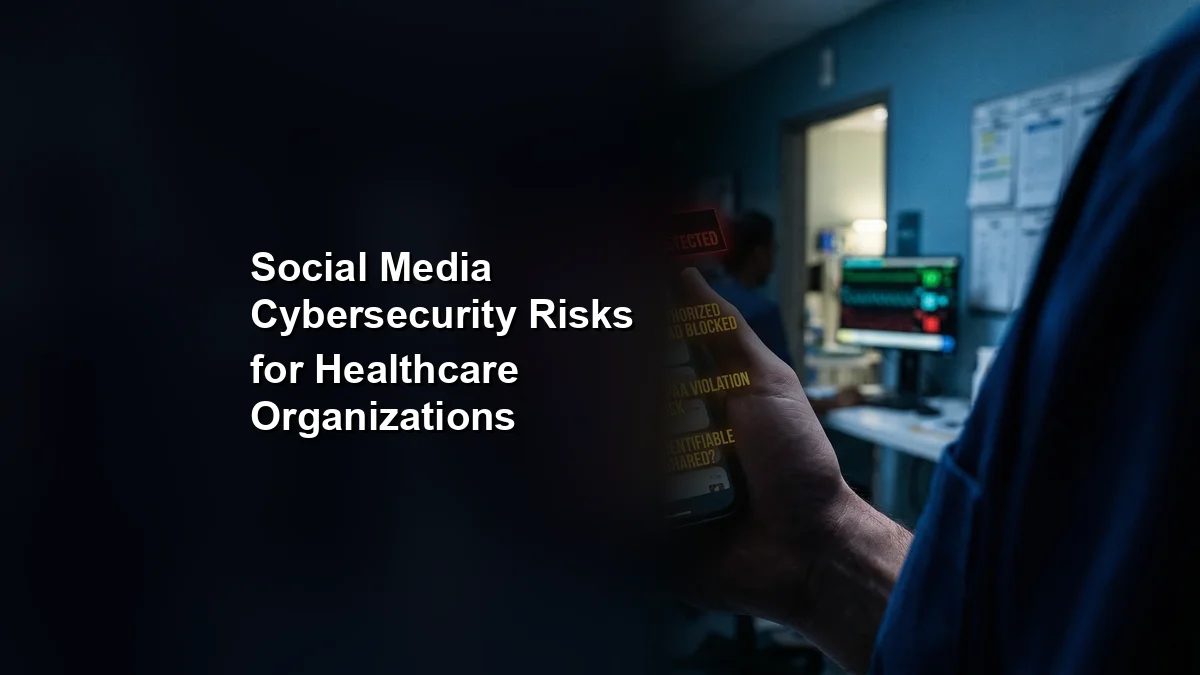
Social media is a powerful tool for healthcare organizations — it builds community trust, supports patient education, and helps recruit talent. But it is also one of the fastest-growing sources of HIPAA violations, cybersecurity exposure, and reputational damage in the healthcare industry. Over 80% of people use social media to research doctors and medical facilities, which means your organization's social media presence is highly visible. When employees post carelessly — or when cybercriminals exploit social platforms to target healthcare workers — the consequences can include OCR investigations, six-figure fines, and loss of patient trust that takes years to rebuild. In 2025, healthcare data breaches affected approximately 57 million individuals across 642 reported incidents, and social engineering via social media platforms was a contributing vector in a growing share of those incidents.
How Does Social Media Create HIPAA Violations in Healthcare?
HIPAA violations on social media happen more often than most practice managers realize, and they don't require malicious intent. Protected health information (PHI) includes any individually identifiable health information — names, photos, medical record numbers, diagnoses, treatment details, and even contextual clues that could identify a patient. Under HIPAA, posting PHI on any social media platform without explicit written patient authorization is a violation, regardless of whether the employee meant to cause harm.
Common scenarios that trigger violations include:
- Workplace photos with visible patient information: A nurse posts a team lunch photo on Instagram — but patient charts are visible on the desk behind them. Even without naming anyone, the visible PHI creates a reportable violation.
- Sharing patient stories without authorization: A healthcare worker posts about an interesting case on Facebook, changing the patient's name but including enough clinical details and demographic information that colleagues — or the patient themselves — can identify who it's about.
- Responding to online reviews: In 2019, OCR fined Elite Dental Associates $10,000 for disclosing a patient's treatment plan, insurance information, and costs while responding to a Yelp review. In June 2023, a New Jersey healthcare provider was fined $30,000 for a similar violation — disclosing mental health diagnosis details in response to a negative online review.
- Patient photos and videos on personal accounts: Cases like the Jackson Memorial Hospital nurse who posted photos of a baby with a birth defect on Facebook, or the Texas Children's Hospital nurse fired for posting details of a pediatric measles case to an anti-vaccination Facebook group, illustrate how quickly social media posts escalate to termination, OCR investigation, and media coverage.
- TikTok and Snapchat incidents: In 2021, a nurse at Citadel Winston-Salem was suspended for posting TikTok videos joking about patient mistreatment. At Glenview Nursing Home, employees were sued after posting a Snapchat video taunting a 91-year-old dementia patient. These cases show that newer platforms create the same HIPAA risks as Facebook and Twitter.
HIPAA civil penalties range from $100 to $1.5 million per violation category per year, and criminal penalties can reach $250,000 and up to 10 years in prison for knowing violations. For the organization, even a single employee's social media misstep can trigger an OCR investigation that examines your entire privacy and security compliance program.
How Do Cybercriminals Exploit Social Media to Target Healthcare Workers?
Beyond employee-caused privacy violations, social media platforms are actively used by cybercriminals as attack vectors against healthcare organizations. In 2025, phishing represented the most common access vector for healthcare data breaches, accounting for 16% of all incidents, and 82% of phishing emails now use AI-generated content that is increasingly difficult to distinguish from legitimate communications.
Social media-specific attack methods include:
- Spear-phishing using social media reconnaissance: Attackers study LinkedIn profiles, Facebook posts, and Instagram stories to learn employee names, titles, reporting structures, and current projects. This information fuels highly targeted phishing emails that reference real colleagues, real events, and real organizational details — making them far more convincing than generic spam.
- Fake connection requests: Cybercriminals create fake LinkedIn profiles posing as medical device vendors, insurance representatives, or recruiters. Once connected, they can message employees directly with malicious links or credential-harvesting forms.
- Social engineering via public posts: When healthcare workers share frustrations about their EHR system, mention the software their practice uses, or post about upcoming conferences, attackers gain intelligence about the organization's technology stack and operational patterns that inform future attacks.
- Credential harvesting through third-party apps: Quizzes, games, and "free tools" promoted on social media platforms often require login credentials or permissions that can be exploited. Healthcare employees who use the same passwords across personal social media and work accounts create direct entry points into clinical systems.
The Blue Shield of California breach in 2025 — which exposed the data of 4.7 million members — was caused by a misconfigured Google Analytics implementation that shared patient data with Google Ads for nearly three years. While not a direct social media breach, it illustrates how interconnected marketing platforms, social advertising tools, and patient data systems have become, and how easily data can leak through these connections.
What HIPAA Rules Govern Social Media Use in Healthcare?
HIPAA doesn't specifically mention social media — the regulations are technology-neutral. But the Privacy Rule, Security Rule, and Breach Notification Rule all apply directly to how healthcare organizations and their employees use social platforms:
- Privacy Rule (45 CFR Part 164, Subpart E): Prohibits disclosure of PHI without patient authorization except for treatment, payment, and healthcare operations. Any social media post containing PHI — even on a private account, even in a closed group — constitutes an unauthorized disclosure unless the patient has signed a valid HIPAA authorization form.
- Security Rule (45 CFR Part 164, Subpart C): Requires covered entities to implement administrative, physical, and technical safeguards to protect electronic PHI. The proposed 2025 HIPAA Security Rule update makes workforce training on social media and phishing risks a mandatory component, eliminating the previous distinction between "required" and "addressable" safeguards.
- Breach Notification Rule: If a social media post constitutes an unauthorized disclosure of PHI, the organization must assess whether the disclosure is a reportable breach. Under HIPAA's presumption-of-breach standard, any unauthorized disclosure is assumed to be a breach unless the organization can demonstrate through a risk assessment that there is a low probability the PHI was compromised.
- Minimum Necessary Standard: Even in situations where some disclosure might be permissible, HIPAA requires that only the minimum necessary information be used or disclosed. Social media posts, by their nature, tend to share more information than necessary.
The proposed HIPAA Security Rule updates expected to be finalized by May 2026 will require healthcare organizations to complete compliance within 240 days of the final rule. This includes mandatory annual cybersecurity training that specifically addresses social engineering and phishing — the attack types most closely linked to social media exploitation.
How Should Healthcare Organizations Build a Social Media Policy?
A defensible social media policy for healthcare should include these elements:
- Clear definition of PHI in social media context: Employees need to understand that PHI includes more than names and medical record numbers. Photos, stories, descriptions of procedures, and even comments about "an interesting case" can constitute PHI if there's any reasonable basis to identify the patient.
- Absolute prohibition on patient-related content: No photos, videos, or descriptions of patients, patient cases, or patient interactions on any personal or professional social media account without explicit written HIPAA authorization from the patient.
- Guidelines for responding to online reviews: After multiple OCR enforcement actions against providers who disclosed PHI while responding to negative reviews, the safest approach is to never reference a patient's treatment, diagnosis, or visit details in any public response. A generic response — "We take all feedback seriously and encourage you to contact our office directly" — is the only HIPAA-safe approach.
- Personal device and account policies: Require employees to use strong, unique passwords for personal social media accounts, enable multi-factor authentication, and never use work email addresses for personal social media registration.
- Reporting procedures: Employees who witness a potential social media violation must have a clear path to report it immediately — to a privacy officer, compliance team, or designated manager — without fear of retaliation.
- Consequences: Document that social media violations will result in disciplinary action up to and including termination and potential legal liability. Reference real enforcement examples to underscore the seriousness.
What Training Should Healthcare Staff Receive on Social Media Risks?
Annual HIPAA training should include a dedicated social media module covering:
- Real-world violation examples: Use the cases above — Jackson Memorial, Elite Dental, Texas Children's Hospital, Glenview Nursing Home — to make the risks concrete and relatable
- Recognizing social engineering attacks: Train staff to identify fake LinkedIn connection requests, suspicious direct messages, and phishing attempts that leverage publicly available information from social profiles
- The "background test": Before posting any workplace photo, check the background for visible patient names, charts, monitors, whiteboards, or any other information that could identify a patient or reveal sensitive operational details
- Password hygiene: Emphasize that passwords used for social media accounts must never be reused for work systems — credential stuffing attacks rely specifically on this common habit
- What to do when you make a mistake: Create a culture where employees report accidental disclosures immediately rather than trying to delete posts and hope no one noticed. A post that's been live for 30 seconds still constitutes a disclosure under HIPAA — but rapid reporting enables faster containment and demonstrates good faith to OCR investigators
The most effective training programs combine annual formal sessions with monthly micro-reminders — short emails, posters in break rooms, or brief huddle topics that keep social media awareness top of mind.
What Should Healthcare Organizations Do Next?
Social media risks in healthcare aren't going away — they're accelerating. As platforms evolve, as AI makes phishing more convincing, and as OCR enforcement becomes more aggressive under the proposed HIPAA Security Rule updates, healthcare organizations need comprehensive policies, regular training, and technical controls that work together to protect patient data.
At NorthStar Technology Group, we help healthcare practices and hospital systems build security programs that address the full spectrum of risk — from social media policies and workforce training to endpoint protection, email filtering, and incident response planning. If your organization's social media policy is outdated, untested, or nonexistent, that's a compliance gap that's overdue for attention. Visit northstartechnologygroup.com/services/healthcare to learn more about our healthcare cybersecurity programs.
About the author

Ken Satkunam, CISM
President & Founder, NorthStar Technology Group
Ken has spent over 25 years in IT leadership, serving in roles from technical support to CIO for organizations as large as 23,000 employees. He founded NorthStar Technology Group in 2000 to help regulated organizations build secure, compliant, and operationally resilient technology environments. Ken holds the Certified Information Security Manager (CISM) credential from ISACA and is the co-author of the Amazon best-seller "Cyber Attack Prevention." He has been quoted in industry publications including eWeek and DM News, and NorthStar has been recognized on the Inc. 5000 list in both 2024 and 2025.